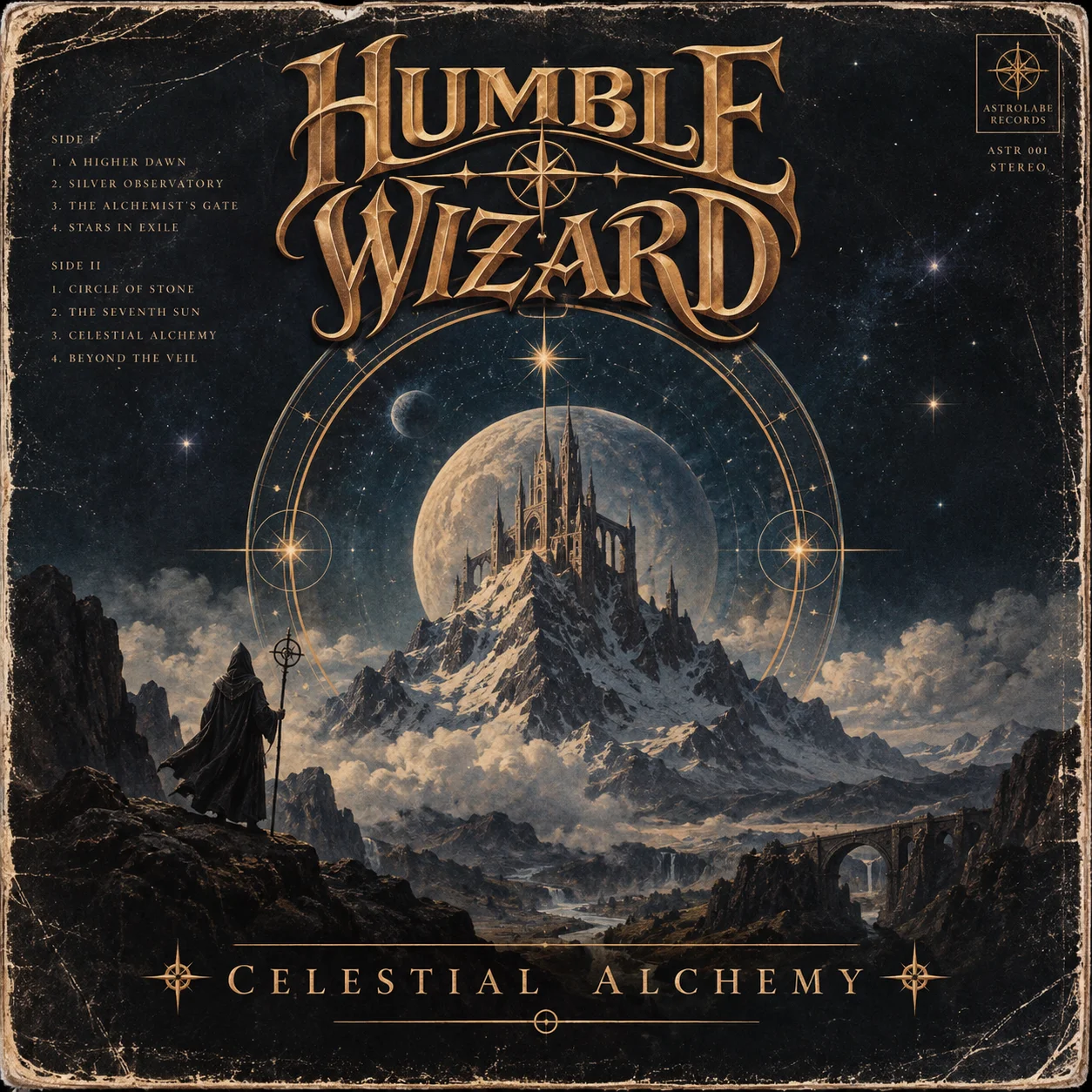
Celestial Alchemy album cover

1978 · Debut studio album

Celestial Alchemy

The earliest recorded Humble Wizard: ambitious, mystical, and progressive, but less fully developed and elaborate than the records that followed. Its music established the foundation around which the band’s visual identity would grow.

Astrolabe Records · ASTR 001
Explore track list Close track list

Track list

Recorded in 1978, Celestial Alchemy captures Humble Wizard before the scale of the concept had caught up with the ambition. The songs are comparatively direct, but the imagery, extended arrangements and early experiments with longer forms already point toward the records that followed.

Side One

  1. The First Conjunction

    4:12

    An early statement of intent, pairing celestial imagery with the direct, riff-driven sound that defined the band's first recordings.

  2. Mercury Rising

    3:46

    One of the album's most immediate songs, built around momentum and a harder-edged approach than much of the material surrounding it.

  3. The Glass Retort

    4:38

    Alchemical imagery moves to the foreground here, with the band beginning to combine heavier passages with more atmospheric writing.

  4. Under a Painted Moon

    5:09

    A more reflective piece that stretches beyond the album's straightforward rock foundations and hints at the more expansive arrangements to come.

Side Two

  1. Salt, Sulphur and Starfire

    4:27

    Mysticism and hard rock collide in one of the record's more eccentric early experiments, already pointing toward Humble Wizard's increasingly theatrical identity.

  2. The Astronomer's Warning

    3:54

    Darker in tone and more narrative in construction, the song suggests the dramatic storytelling that would become more prominent on later records.

  3. Vessel of the Sun

    4:41

    A broader, more melodic composition that feels like an early bridge between the band's raw beginnings and the more ambitious work that followed.

  4. Celestial Alchemy

    8:36

    The album's centerpiece and first extended composition, moving through several contrasting sections in an early attempt at the long-form structures that would later become a Humble Wizard hallmark.
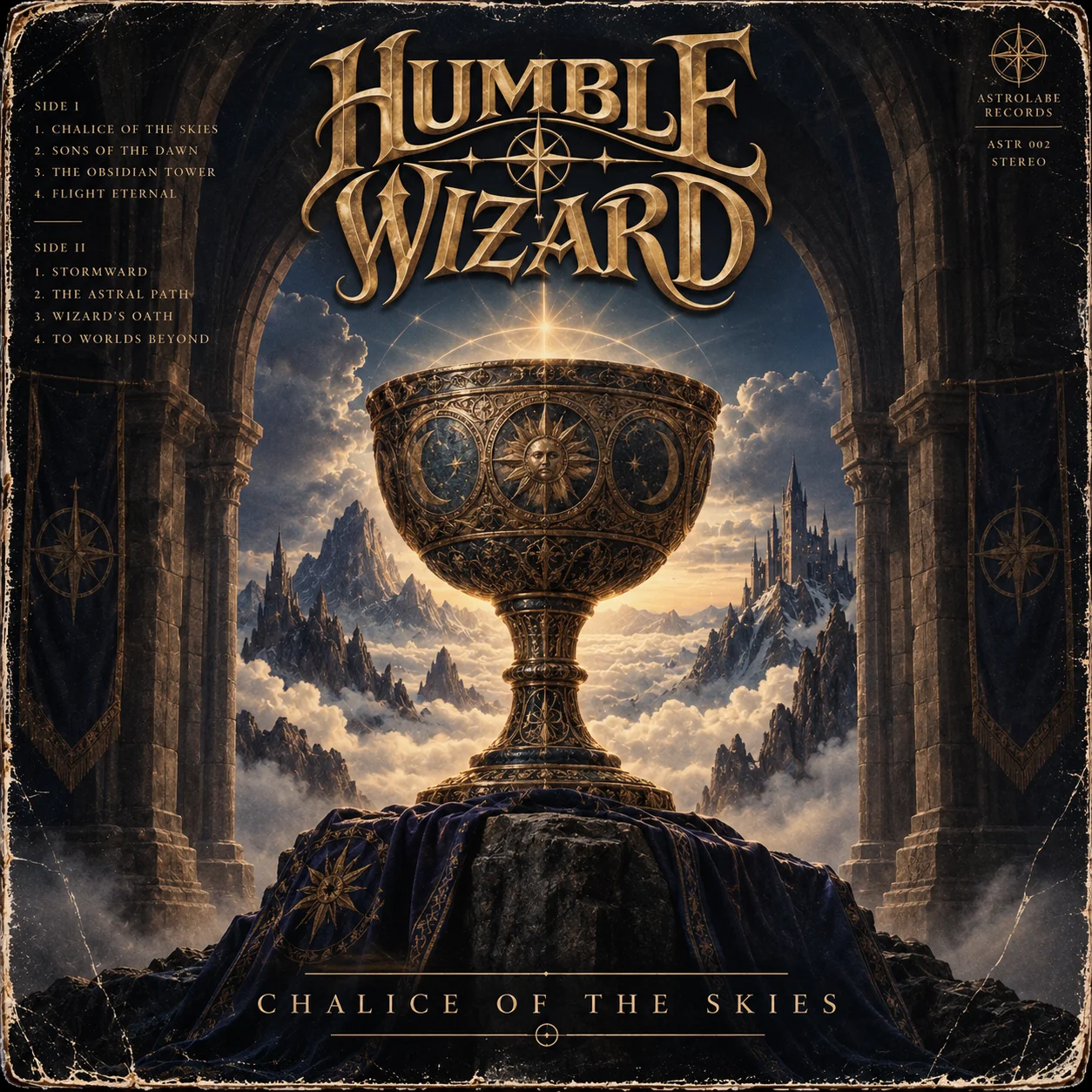
Chalice of the Skies album cover

1980 · Second studio album

Chalice of the Skies

The breakthrough-era record: more confident, elaborate, and expansive in production, and more fully representative of Humble Wizard’s emerging musical and theatrical identity.

Astrolabe Records · ASTR 002
Explore track list Close track list

Track list

Recorded in 1980, Chalice of the Skies marked the point at which Humble Wizard’s early ideas became a coherent identity. The songs grew longer, the arrangements more deliberate, and the band’s increasingly elaborate instrumentation became part of the compositions themselves rather than decoration around them.

Side One

  1. Procession of the Chalice

    4:41

    The record opens ceremonially rather than explosively, building from tolling percussion and a restrained guitar figure into the first full statement of the album’s central musical theme.

  2. Beyond the Navigator’s Glass

    5:32

    A driving progressive-rock piece built around shifting meters and a rising vocal melody, with the lyrics using celestial navigation as a metaphor for uncertainty, ambition, and direction.

  3. Crown of Embers

    4:18

    One of the album’s more immediate songs, pairing a heavier guitar riff with dramatic vocal harmonies and a chorus that became a natural centerpiece of the band’s live set.

  4. The Long Meridian

    7:26

    The first truly extended Humble Wizard composition. Its sections move between acoustic passages, layered electric guitars, and an instrumental middle built around Sebastian’s keyboards and Dex’s expanding percussion setup.

Side Two

  1. Bells Beyond the Firmament

    5:07

    A darker, more atmospheric piece in which bells, metallic percussion, and sustained guitar tones create the sense of something enormous sounding from beyond the visible sky.

  2. A Measure of Stars

    4:54

    More reflective than most of the album, with a slow-burning arrangement and one of Sebastian Vale’s earliest performances built around restraint rather than theatrical force.

  3. The Cup and the Crown

    6:11

    A muscular, theatrical track that contrasts earthly power with the unknowable scale of the heavens. Rafe’s guitar becomes increasingly elaborate as the song progresses toward a dense ensemble finale.

  4. Chalice of the Skies

    9:02

    The album’s title suite and its most ambitious composition to date. Themes introduced earlier on the record return in altered forms across several connected movements, culminating in a large-scale finale of guitars, keyboards, bells, gong, and layered vocals.

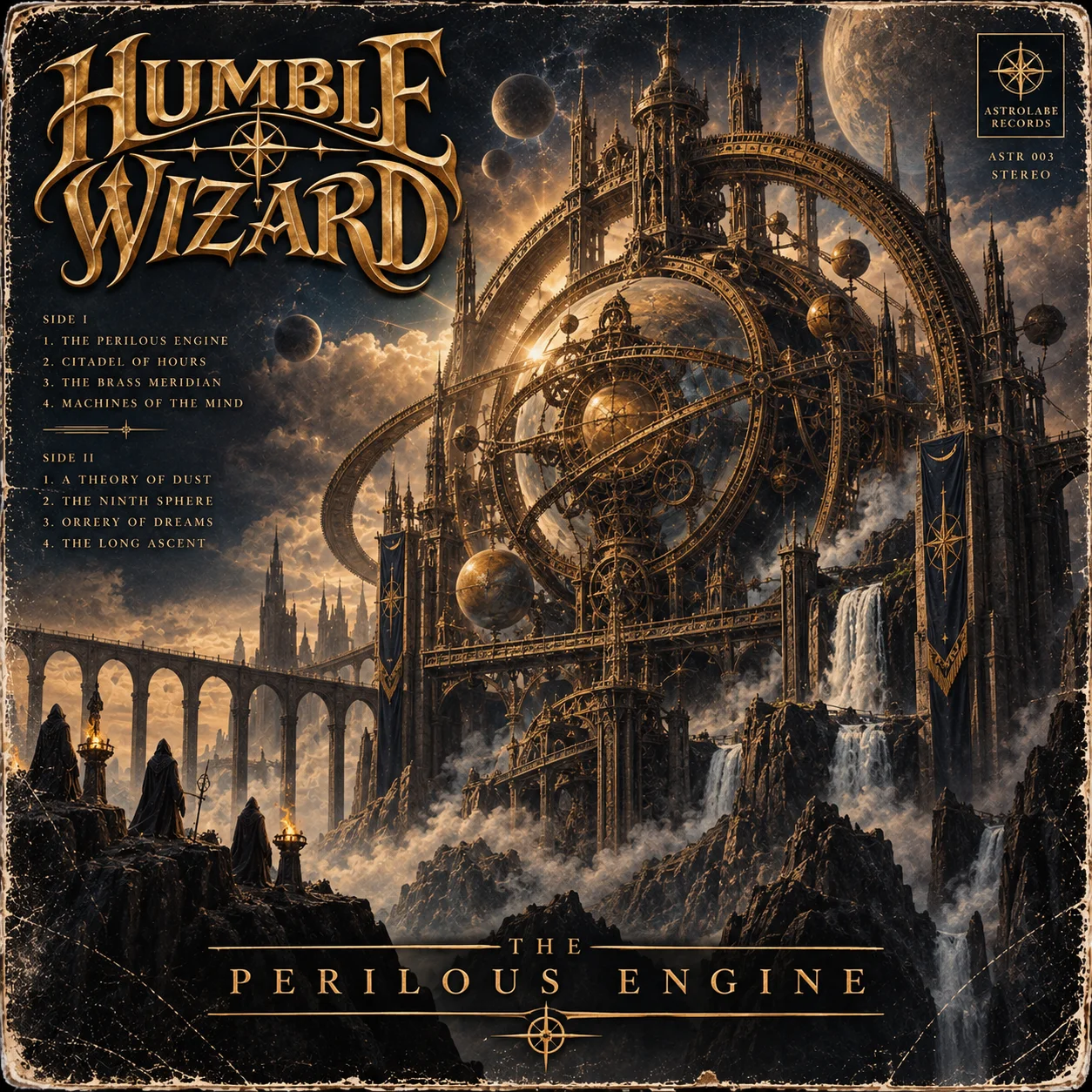
The Perilous Engine album cover

1982 · Third studio album

The Perilous Engine

Humble Wizard at its most structurally ambitious progressive-rock period up to that point, joining interconnected passages, recurring motifs, layered guitars, odd meters, and large dynamic changes.

Astrolabe Records · ASTR 003
Explore track list Close track list

Track list

Recorded in 1982, The Perilous Engine was Humble Wizard’s first deliberately interconnected album. Individual songs remained distinct, but recurring musical themes, continuous transitions, and shared instrumental passages increasingly tied the record together as a single work. It marked the band’s move from elaborate progressive rock toward the larger, more theatrical structures that would define the period that followed.

Side One

  1. The Turning House

    7:08

    The album begins almost mechanically, with a repeating figure that gradually accumulates bass, percussion, guitar, and keyboards. Several melodic fragments introduced here recur throughout the record in altered forms.

  2. Brass Meridian

    6:34

    A tense, propulsive piece built around interlocking guitar lines and irregular meters. The arrangement repeatedly accelerates and contracts, giving the impression of a machine operating just beyond safe tolerances.

  3. The Perilous Engine

    10:17

    The centerpiece of Side One and the band’s most complex composition to date. Multiple sections move from heavy ensemble passages into quieter instrumental interludes before rebuilding around the album’s central rhythmic motif. The final passage does not fully resolve, instead leading directly into Side Two.

Side Two

  1. Chamber of Measures

    5:56

    Opening almost as if the previous track never ended, this quieter movement strips the recurring themes down to piano, restrained guitar, bass, and sparse percussion before gradually reassembling them.

  2. The Weight of the Wheel

    7:42

    One of the album’s darkest pieces, with a slow, massive rhythm supporting increasingly dense layers of guitar and keyboards. Earlier melodic ideas reappear here in distorted and heavier forms.

  3. When the Engine Sleeps

    9:11

    A long-form finale that begins in near silence and gradually revisits themes from across the record. The closing section expands into a full-band climax before collapsing back to the same mechanical pulse heard at the album’s opening, leaving the ending intentionally unresolved.

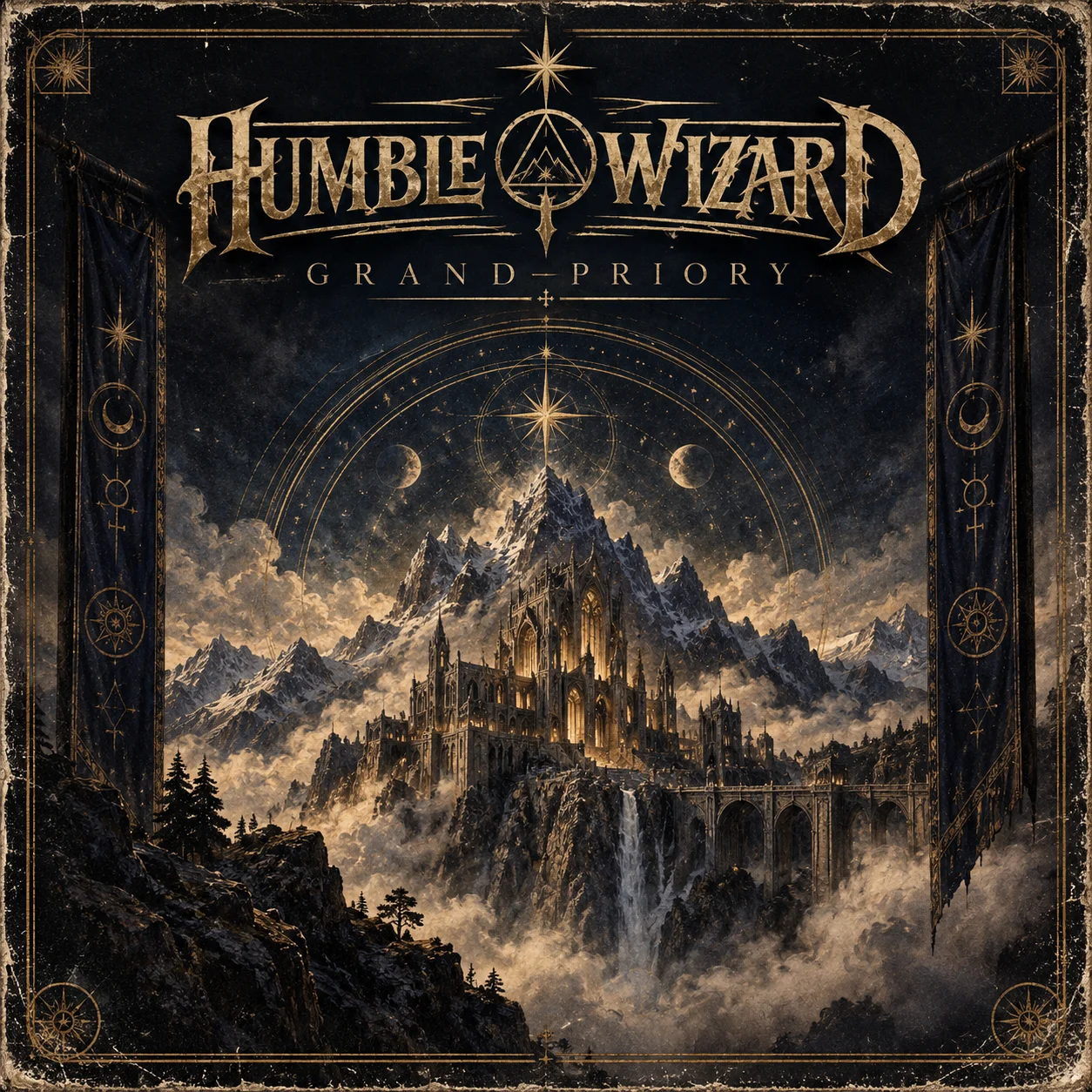
Grand Priory album cover

1983 · Fourth and most recent studio album

Grand Priory

A large-scale but more controlled record, with the band using its elaborate musical vocabulary with increasing confidence and focus. Humble Wizard’s fourth and most recent studio album includes “Alchemy at the Summit.”

Astrolabe Records · ASTR 004
Explore track list Close track list

Track list

Recorded in 1983, Grand Priory found Humble Wizard fully embracing the long-form, theatrical approach that had emerged on The Perilous Engine. Individual tracks function increasingly as movements within a larger work, with recurring themes, continuous transitions, and ceremonial arrangements tying the record together. At its center, the comparatively concise “Alchemy at the Summit” distills the album’s ideas of transformation, ascent, and celestial ritual into one of the band’s most direct compositions.

Side One

  1. Procession to the Grand Priory

    7:18

    A slow ceremonial opening that introduces several of the album’s recurring melodic ideas before expanding into a full-band passage of layered guitars, keyboards, bells, and percussion. Rather than ending cleanly, its final motif leads directly into the next piece.

  2. Alchemy at the Summit

    2:56

    A compact burst of cosmic mythology amid the album’s larger structures. The song follows a solitary sage transforming earthly doubt into celestial illumination, moving quickly from verse and chorus through a brief guitar feature to its final declaration of triumph.

  3. The Golden Vessel

    9:46

    Building on imagery introduced in Alchemy at the Summit, this extended composition shifts between restrained passages and increasingly elaborate ensemble sections. Musical themes associated with transformation and ascent recur in different forms before the side closes on an unresolved chord.

Side Two

  1. Cloister of the Turning Stars

    10:38

    The album’s darkest and most architectural piece, beginning with sparse keyboards and distant percussion before developing into a sequence of interlocking sections. Earlier themes return beneath heavier guitar writing as the music gradually takes on the scale of a ceremonial procession.

  2. Grand Priory

    13:21

    Humble Wizard’s largest composition to date and the culmination of the musical language developed across the previous three records. Themes from throughout the album reappear across several connected movements, moving from quiet choral passages through dense instrumental sections before resolving in a final convergence of guitars, keyboards, bells, gong, and layered vocals.